
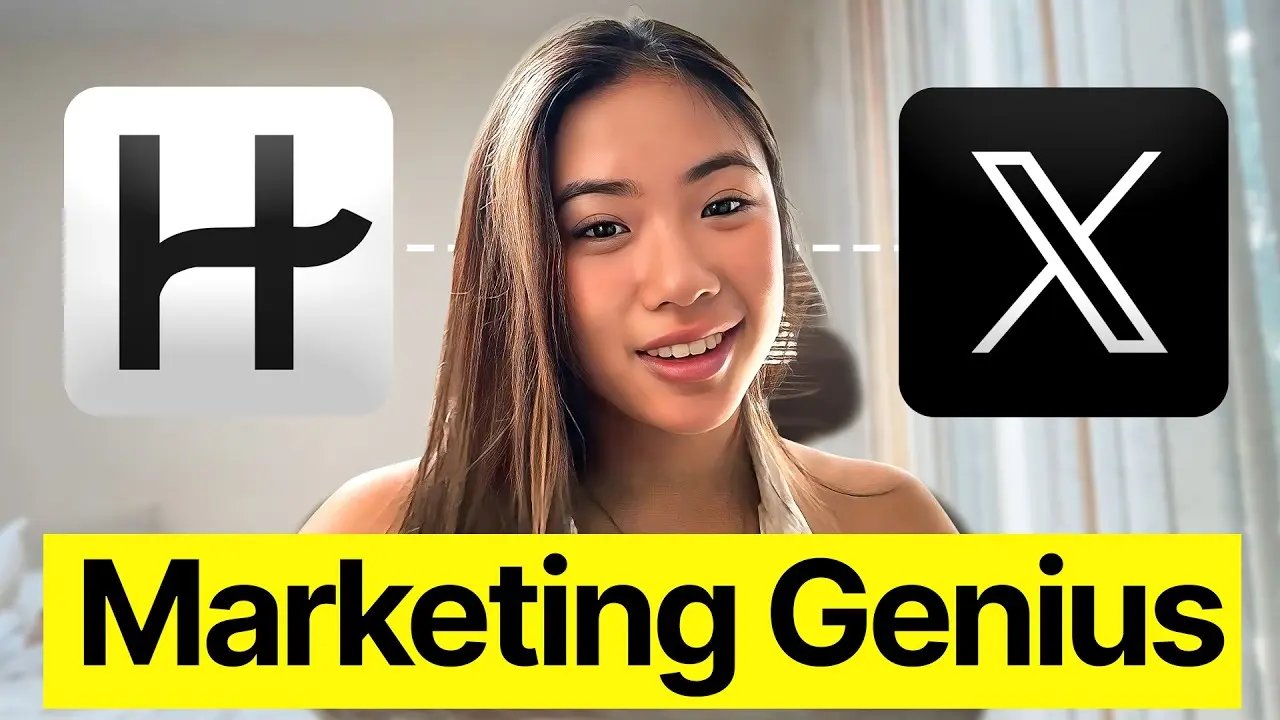

The secret to blowing up your startup isn't your product, your funding, or your connections. It might just be finding the right college student who treats dating apps...like user acquisition funnels?
In today's recap of our podcast interview, Joseph sat down with Eunice Lai, a 20-year-old college student who became the CMO of Series, a viral startup. Her track record includes over 3 million impressions across LinkedIn and Twitter, three viral launch videos, and some truly unconventional marketing tactics.
If you haven't watched the full interview yet, I'd recommend checking it out below:
But as always, here's my breakdown of the key points:
The Hinge strategy that broke "Tech Twitter"
When Eunice joined the startup world this summer, she knew X was where the conversations happened. Her first post got 20 likes, which sounds like nothing, but as she puts it, "that's a lot more than most people on X because most people stay in one, two, three likes jail." She started with the typical "build in public" approach everyone was doing.
So instead, she tried something different. When she was in New York for her first summer, she hooped on Hinge. In her bio, she listed "startup" as her job. When matches asked what kind of startup she worked at, instead of giving a straight answer, she'd drop playful hints like "the first AI social network."
Her breakthrough came from a real interaction. A guy searched her up after matching and messaged "Series is cool." Her response? "So you're trying to become a user." She tweeted the exchange and named him "Jason [Hinge]" in the screenshot. People found the idea of reducing a date to a potential conversion both absurd and hilarious. That's when the tweet went viral.
But here's the part that actually surprised me, she actually went on the date! And...she actually converted him! She walked him through the entire onboarding process and watched him become a user in real time. "I didn't want it to be too overt," she explains. "We had a really good time. We talked about life and ambitions before I popped the question at the end." The user conversion question, that is.
So, how does this relate to tech marketing? Let's get to that part next.
Doing the opposite and why calm content converts
Eunice's approach to content is deceptively simple: "Do the opposite of what people are doing right now." I think her Hinge setup embodies that well, too. And that's where her inspiration came from.
Aside from Hinge, Her Instagram reels are a perfect example. While everyone was making vertical videos with loud text and rage-bait hooks, she posted a horizontal video of herself just talking for 90 seconds. The view count wasn't massive at 35,000, but it converted between 200 and 250 followers. That's an incredibly high conversion rate for Instagram. So, why did it work?
I think the main reason was because it was different (true to her marketing and posting ethos). People scrolling through endless vertical content suddenly saw something calm and authentic. It felt like connecting with a real person instead of consuming another algorithm-optimized piece of content.
She also pointed out something that more creators are discovering: you have to full send the persona. "If you only put a foot in the door, people are going to be able to tell that maybe this is not your true self and you're trying too hard. But if you really put your entire brand into it, the smart people realize you know what you're doing and they play along with it."
The trick is taking one small aspect of your personality that's genuinely true and playing it up to the max. On the internet, you're in a crowd of a hundred people, so you have to amplify yourself to stand out.
The campaign that pulled 2,500 applications
So, with a good format and ideas that worked, she started using these ideas at Series.
For Series, Eunice ran a campaign around their Hamptons event that showcased how social proof compounds. She had interns compete for a spot in a reality TV-style show about startups. The challenge format tapped into something she'd identified about viral content: people love the day-by-day journey. They want to see if you can actually achieve your goal, so they follow along.
They made a LinkedIn post and job listing about it. Over 2,500 people applied. Initially, the show only had 12 spots, but Eunice saw an opportunity. Why waste all that interest? She turned it into a competition where 150 people joined the "race to the Hamptons." One of the final challenges was to invite as many people as possible. The first-place person invited 120 people in a single day.
She noticed something interesting about LinkedIn specifically. Students don't usually like to post there, but once one or two people started sharing about the campaign, everyone became comfortable doing the same. Within two days, over a hundred interns had posted banners and paragraphs about what entrepreneurship meant to them. "LinkedIn is such an undervalued channel for students," she says. "I would say the highest value followers you can have are probably LinkedIn followers."
What founders get wrong when hiring creators
When startup founders reach out to Eunice now, she can immediately tell who's put thought into their approach and who hasn't. The bad pitches are the ones that just say "I want my own version of a TV show" because they saw something go viral. They're looking to her for all the ideas without bringing anything to the table themselves. There has to be genuine ideas coming from both sides.
The good pitches, though, come from founders who understand their target audience and have at least a hypothesis about what might resonate. "I think it's very clear when a founder isn't putting thought into how they want to approach it," she explains. The pitch that works sounds more like: "My target audience is this, I think they might appreciate a campaign like this because they love watching Love Island, so let's see how we can spin up our own version." That kind of thinking reflects on the product itself.
She also emphasizes that big creators who are good at building their own brand don't necessarily know how to build someone else's. That point resonated with me, I've tried a little bit of influencer reach-out myself. Conventional wisdom would usually lead you to thinking that the bigger the influencer, the better the results.
So, Eunice trained herself specifically to make content from the perspective of a company or brand, telling their story rather than her own. That's a different skill set than just having a lot of followers.
Managing creative talent without killing creativity
For startup founders wondering how to work with content creators, Eunice's advice is simple: let them cook!
The more you prescribe formulas and detailed requirements, the less creative people feel. Creative burnout is real, especially when you're trying to generate fresh stories from a single concept. If you put more pressure on them with strict quantitative KPIs, they won't execute as well as they could. You can't set a goal like "this video has to get a million likes." Even creators with a million followers can't guarantee that. Virality is part strategy, part luck. And, that's something we see over and over with these interviews we do.
Instead, focus on qualitative goals. Does the content reflect your brand identity? Are users taking away the right information? You can set quantitative goals once you have actual data points to work with, but in the beginning, make sure your marketing person understands who the user is and what the goals are. Then let them figure out how to get there. Trust them. That's how you get the best work.
Wrapping up
Eunice represents something I think a lot of founders are starting to realize. The social media intern isn't at the bottom of the totem pole anymore. In many ways, they've become the most important person for distribution. The tables have completely turned.
Her success comes from recognizing that behind every viral moment is a real human story. By staying authentic while playing with the conventions of social media, she's created content that doesn't just get views but builds community. For startup founders, the lesson is clear: find people who can turn boring topics into engaging stories, give them the freedom to experiment, and focus on building relationships rather than just chasing metrics. Look for potential over follower count. Someone who's built accounts from the ground up understands engagement mechanics in ways that people who inherited large followings might not.
As always, if you're ready to test your paywall, run price tests, and more for your app, you're already in the right spot. Sign up for a free Superwall account today!